
Most people are surprised to learn this: Utah has the highest concentration of Brazilians of any state in the country.
Many people think that Florida or Massachusetts has a higher number. While Florida has over 100,000 Brazilian residents and Massachusetts has the largest raw number, Utah has 23% of its population identifying as Brazilian, making it the nation's leader.
If you live in Utah County and have ever wondered why you hear Portuguese at the grocery store, why there is a Portuguese immersion program at local elementary schools, or why a Brazilian festival in Orem draws over 10,000 people every September, this is the answer.
Why are there so many Brazilians in Utah?
The connection between Brazil and Utah runs deeper than most outsiders realize, and it starts with The Church of Jesus Christ of Latter-day Saints.
The LDS Church has been sending missionaries to Brazil since 1928. Over the following decades, that missionary presence grew into one of the largest and most active church communities in South America. Today, Brazil is home to over 1.5 million LDS members, making it the third-largest LDS membership in the world, behind only the United States and Mexico. The Church's second-largest missionary training center outside of Provo is in São Paulo.
What this means for Utah County specifically is significant. Thousands of young men and women from Brazil have served missions in Utah and the surrounding region, fallen in love with the area, and returned to build their lives here. Simultaneously, thousands of Utah residents have served missions in Brazil, returned home with a deep connection to Brazilian culture, language, and food, and brought that affinity back to communities like Provo, Orem, Lehi, and American Fork.
In 2008, Orem became home to the first Portuguese-speaking LDS ward in the United States. The Utah State Office of Education launched a dual language Portuguese immersion program in select elementary schools the same year. The Brazilian community in Utah is estimated at around 30,000 residents by community leaders, and that number continues to grow alongside Utah County's overall rapid population expansion.
The Utah Brazilian Festival
Every September, Utah County hosts one of the most unexpected cultural celebrations in the Mountain West.
The Utah Brazilian Festival began in 2005 when a small group of Brazilian immigrants in Utah decided they wanted to celebrate their heritage and share it with the community that had embraced them. Matilde Wosnjuk, originally from São Paulo and now living in Eagle Mountain, was one of the organizers. She had noticed festivals celebrating other cultures across Utah and felt Brazil deserved its own moment.
Twenty years later, the festival draws over 10,000 attendees annually. It has been held at University Place in Orem for the past several years, running from noon to 7 p.m. on a Saturday in early September. The festival features live music, a Samba Parade, capoeira demonstrations, Brazilian vendors, and traditional food from churrasco to pão de queijo.
It is free and open to all ages, and it is genuinely one of the most energetic community events in Utah County each year. If you have never been, mark your calendar for the first Saturday of September.
Brazilian Food in Utah County: What's Available
The Brazilian food scene in Utah County has grown alongside the community itself. Here is an honest overview of what you will find:
Churrascarias and Brazilian steakhouses have had a presence along the Wasatch Front for years. Tucanos Brazilian Grill, which operates rodizio-style service, has been one of the most prominent Brazilian dining destinations in the region. These restaurants have introduced countless Utah residents to picanha, fraldinha, linguiça, and the churrasco tradition.
Brazilian bakeries and specialty shops have come and gone over the years, reflecting the natural ebb and flow of small immigrant-owned businesses. Pão de queijo, brigadeiro, and other Brazilian sweets have found their way into specialty markets and Brazilian-owned businesses scattered across the valley.
Portuguese immersion schools have become a gateway to Brazilian culture for non-Brazilian families. Parents whose children attend Portuguese immersion programs often develop a genuine interest in Brazilian food and culture as they support their children's language learning.
Home cooks and community gatherings are where some of the most personal Brazilian food lives. Within the Brazilian LDS community, especially, food is central to cultural gatherings, ward activities, and family celebrations. Backyard churrasco among friends and family is a tradition that traveled here from Brazil and took root.
What Makes Brazilian Churrasco Distinctive
Whether you have tried churrasco at a restaurant in Utah County or have never encountered it before, it helps to understand what the tradition actually involves and what distinguishes different approaches.
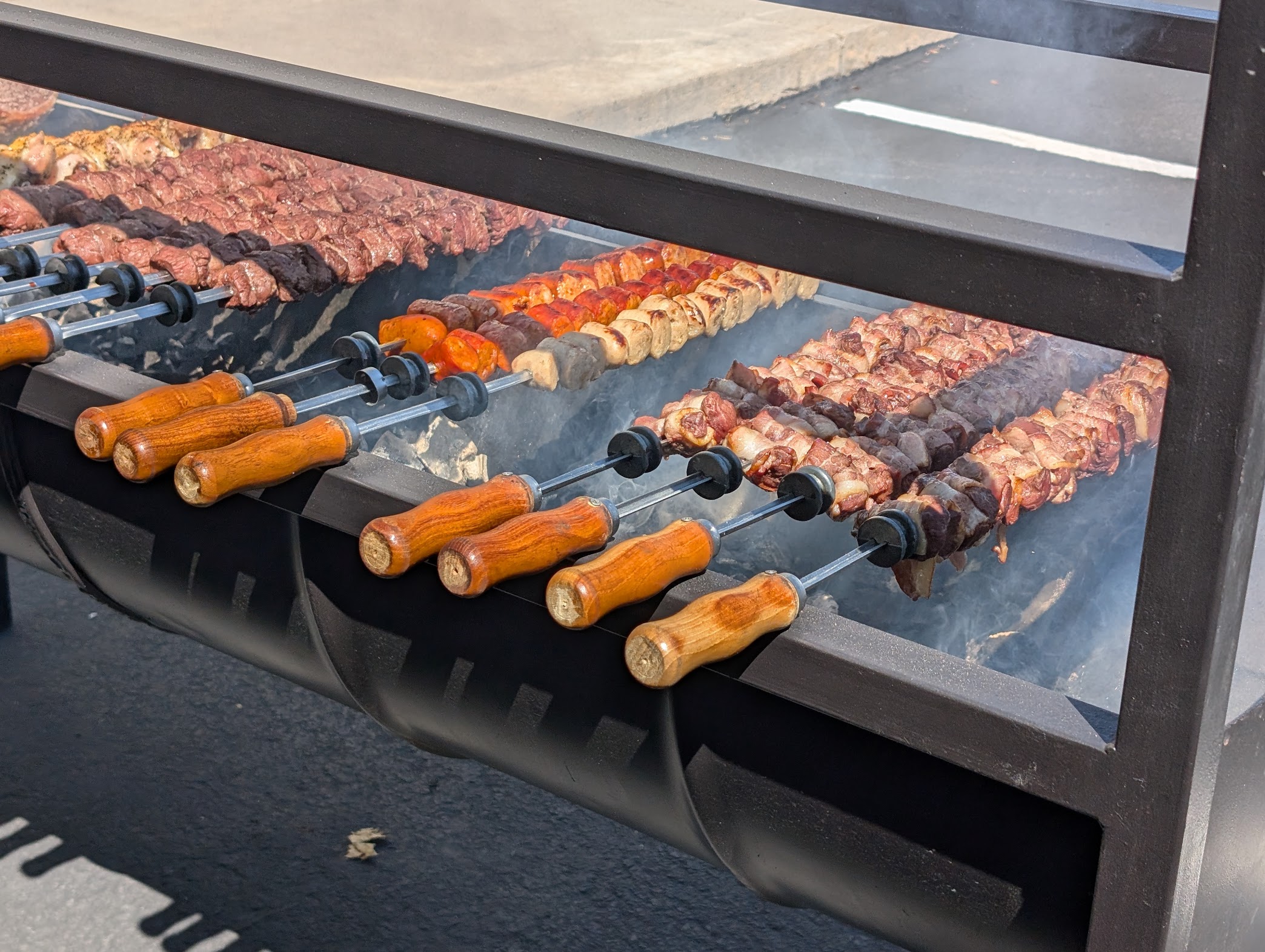
The espeto. The defining tool of churrasco is the long, flat-bladed metal skewer. Cooking on the espeto over an open fire is what gives churrasco its identity. It is a fundamentally different technique from cooking on a grill top, even when the same cuts and seasonings are used. The skewer controls how the meat interacts with the fire, how the fat renders, and how the exterior develops. Brazilian restaurants that use the espeto tradition are honoring a tradition that dates back to the gauchos of the Pampas.
The cuts and their preparation. Each cut has a specific relationship with the skewer and the fire that is part of the tradition: Picanha folded into a C-shape with the fat cap facing the fire, Fraldinha cooked whole and sliced tableside, and Linguiça going directly from the fire to the guest.
The seasoning philosophy. Coarse salt, applied simply and deliberately, is the foundation. The goal is to enhance the meat. This restraint is itself a technique.
The fire source. Restaurants and home cooks make different choices here based on their setup and priorities. Gas is consistent, efficient, and used by many excellent churrascarias. Hardwood charcoal creates a different dynamic: as fat renders from the meat and drips onto the coals, it vaporizes and returns as smoke, creating a continuous flavor exchange between the meat and the fire.
At The Espeto Grill, we cook over hardwood charcoal. We think it makes a difference in depth of flavor, particularly in cuts with a significant fat layer like picanha, and especially in the grilled pineapple. We are not here to knock anyone else's approach. This is simply our favorite way to enjoy it.
Authentic Churrasco in Lehi, Utah
The Espeto Grill is a licensed Microenterprise Home Kitchen operation in Lehi, Utah, cooking authentic Brazilian churrasco every Saturday over hardwood charcoal on a custom nine-zone churrasqueira.
The connection to Brazil is not a marketing angle. The founder served as a missionary in Santa Catarina, Brazil, from 2001 to 2003, spent two decades studying and refining the craft of churrasco do espeto, and built the operation from a proof-of-concept barrel grill to a licensed Saturday cook service.
The menu includes picanha, fraldinha, linguiça, grilled pineapple, and all the classic Brazilian sides: white rice, Brazilian black beans, farofa, and vinaigrette. Add pão de queijo, fresh-baked the same morning by hand, and a Brazilian limeade. You have a complete Brazilian meal without leaving Utah County.
Order by Thursday at 10 p.m. for Saturday pickup or delivery within our service area at espetogrill.com.
A note for Utah County's Brazilian community
If you grew up eating churrasco in Brazil and have been looking for something that tastes like home, we would love to cook for you.
We use hardwood charcoal. We use coarse salt. We use the same cuts you grew up eating. And we care about getting it right in a way that only someone who has spent years learning the tradition can.
Come find us on a Saturday.
Frequently asked questions about Brazilian food in Utah County
Why are there so many Brazilians in Utah? Utah has the highest concentration of Brazilians of any US state, primarily due to the deep connection between The Church of Jesus Christ of Latter-day Saints and Brazil. Thousands of LDS missionaries have served in Brazil over the decades, and many Brazilian LDS members have relocated to Utah. The estimated Brazilian community in Utah numbers around 30,000.
Is there a Brazilian festival in Utah County? Yes. The Utah Brazilian Festival is held annually at University Place in Orem, typically on the first Saturday of September. The festival features live music, a Samba Parade, capoeira demonstrations, Brazilian food vendors, and cultural exhibitions. It is free and open to all ages, regularly drawing over 10,000 attendees.
Where can I find authentic Brazilian churrasco in Utah County? The Espeto Grill in Lehi, Utah, cooks authentic charcoal-fired Brazilian churrasco every Saturday for pickup or delivery. Order at espetogrill.com by Thursday at 10 p.m.
What is the difference between Brazilian churrasco and regular BBQ? Brazilian churrasco is cooked on long, flat-bladed skewers called espetos over an open fire. The cuts, seasonings, and cooking techniques are distinct from American barbecue. The espeto tradition shapes how the meat interacts with the fire and how the fat renders throughout the cook. Some operations use hardwood charcoal, which creates a smoke and fat exchange that adds depth of flavor. Others use gas for consistency. Both produce good food. The technique and the cuts are what define churrasco as a tradition.
Does Utah County have Portuguese language programs? Yes. The Utah State Office of Education launched a Portuguese dual language immersion program in select elementary schools beginning in 2008, the same year the first Portuguese-speaking LDS ward in the United States was established in Orem. Several schools along the Wasatch Front offer Portuguese immersion today.
What Brazilian foods are popular in Utah County? Churrasco, pão de queijo, brigadeiro, and feijoada are among the most recognized Brazilian foods in Utah County. Pão de queijo in particular has gained significant popularity beyond the Brazilian community and can be found in specialty markets and Brazilian-owned food businesses across the valley.