
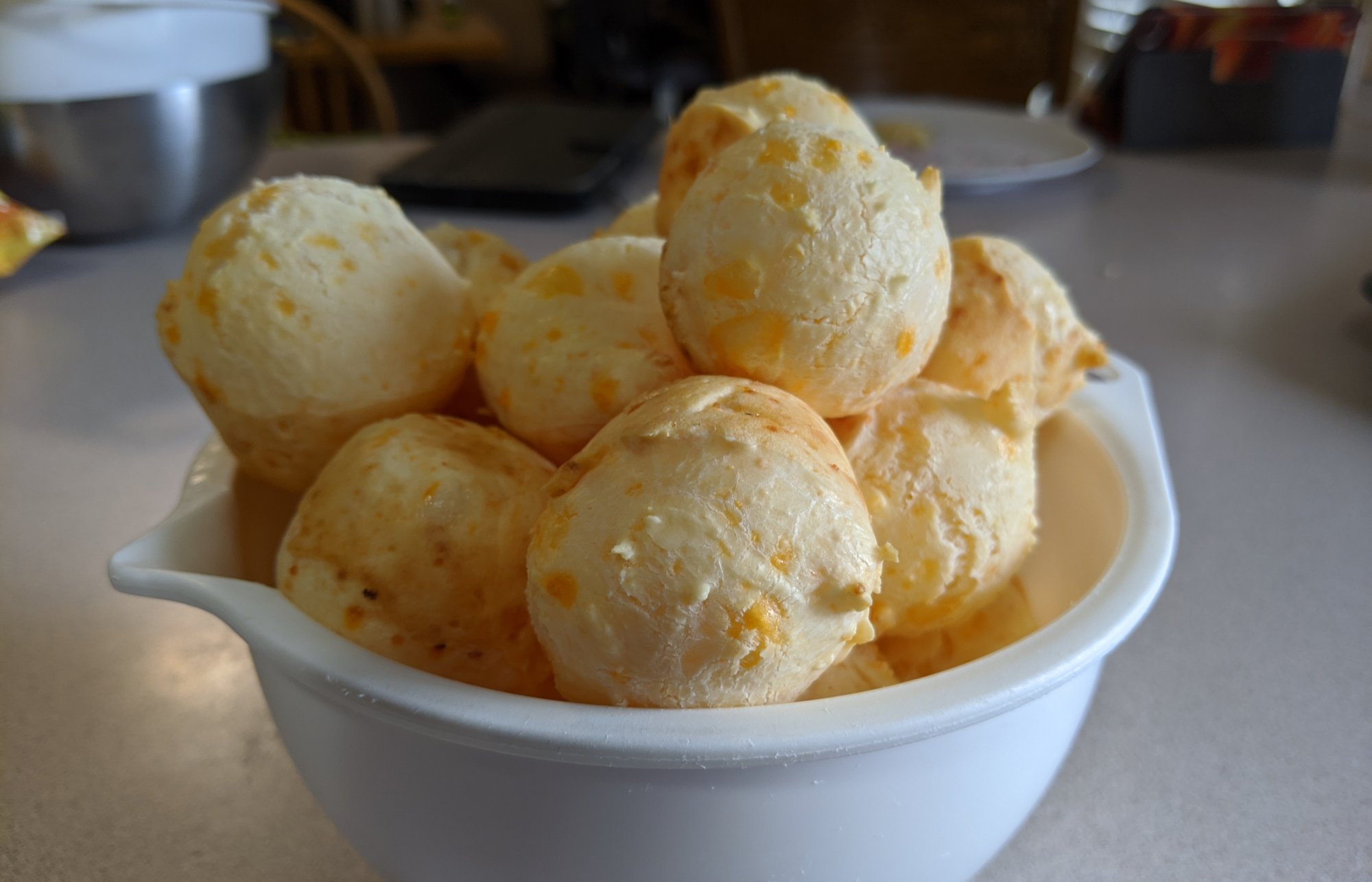
Every night on the way home, we would deliberately walk past the padaria.
A padaria is a Brazilian bakery, and the one around the corner from where I lived in Itaum, Santa Catarina was run by a baker who seemed to be waiting for us. We would barely turn the corner before he would come running out with a bag full of fresh pão de queijo, still warm, straight from the oven.
My companion and I would spend the next several hours eating our way through that bag.
I did not understand at the time that he was giving them away because pão de queijo does not keep. You cannot sell today's batch tomorrow. By morning it is stale. By the following evening it is too hard to enjoy. So the baker's choices were to give his excess to people he knew would love it, or to throw it away.
He chose to give. And I chose to walk that route home every night.
What Is Pão de Queijo?
Pão de queijo, pronounced pow-djee-KAY-zhyoo, is Brazilian cheese bread. Unlike American cheesy breads that bake shredded cheese into flour dough or sprinkle it on top of rolls, pão de queijo is made entirely with tapioca starch. There is no wheat flour in the traditional recipe. The cheese is infused throughout the entire dough.
The result is something unlike anything in the American baking tradition. The outside develops a thin, slightly crispy shell during baking. The inside stays soft, chewy, almost gooey, with a slight pull that reminds some people of a Yorkshire pudding or the inside of a German pancake. The texture is addictive in a way that is difficult to describe until you have experienced it.
And then you experience it, and you understand immediately why Brazilians serve it at every churrascaria.
Pão de queijo is naturally gluten free. Tapioca starch contains no gluten. When made without any added flour, the recipe is also suitable for those monitoring carbohydrate intake, though individual responses to tapioca starch vary.
Where This Recipe Comes From
I learned this recipe from a young baker named Renato.
Renato invited us into his kitchen and walked us through the entire process. I remember the moment he pulled the just-boiled mixture of water, oil, and milk from the stove and told me to pour it slowly into the tapioca starch while mixing with my hands.
It burned.
As I was trying to work the scalding liquid into the starch, which was sticking to my hands like tar, Renato would giggle and tell me I had mãos finas. Delicate hands. I have since adapted to using a wooden spoon, which I strongly recommend, though I understand if you feel the need to test your own hand durability.
This is the exact recipe Renato shared with me. I have made it hundreds of times since returning home. The measurements are the same. The process is the same. What changes is the cheese, which I will discuss at the end.
The Recipe
Ingredients
1 kg (1000 grams) tapioca starch
250 grams parmesan, grated
250 grams sharp cheddar, grated
300 ml vegetable oil
300 ml water
300 ml whole milk
6 large eggs
1 tablespoon salt
Equipment: Mini muffin tin, medium saucepan, wooden spoon, oven
Yield: Approximately 48 to 60 pieces depending on scoop size Prep time: 25 minutes Cook time: 15 to 20 minutes Total time: 45 minutes
Instructions
Step 1: Combine the liquids Add the water, milk, oil, and salt to a medium saucepan over medium-high heat. Bring the temperature to 190 degrees Fahrenheit, just below boiling. Do not allow it to reach a full boil. Watch it closely.
Step 2: Incorporate into the tapioca starch Place your tapioca starch in a large bowl. Pour the hot liquid mixture slowly into the starch, a little at a time, mixing as you go. This is the step Renato had me do with my hands. Use a strong wooden spoon. Pour some, mix some, pour some more. Repeat until all of the liquid is fully incorporated. The mixture will be thick and slightly sticky.
Step 3: Add eggs and cheese in thirds Add one third of the eggs to the mixture and stir until incorporated. Then add one third of the cheese and stir again. Alternate between eggs and cheese in one third increments until everything is fully mixed in. As you do this the dough will become smoother but thicker. This is correct.
Step 4: Check the consistency The finished dough should resemble thick oatmeal. It will be slightly sticky and will hold its shape when scooped. The consistency will vary slightly based on the type of cheese used, the size of your eggs, and how thoroughly you mixed in step 2. Small variations are normal and will not affect the final product.
Step 5: Scoop into a mini muffin tin Preheat your oven to 400 degrees Fahrenheit. Spray a mini muffin tin generously with cooking spray. Using a tablespoon or small cookie scoop, fill each cup to about three quarters full. The bread will expand upward during baking.
Step 6: Bake Place the tin on the middle rack and bake for 15 minutes. The pão de queijo is done when it is light golden brown and has risen above the rim of the muffin cup.
Step 7: Cool briefly and serve immediately Remove from the oven and allow to cool for two to three minutes. They will be extremely hot inside and full of steam. Eat them within the first ten minutes for the best texture and flavor. They are still good within the first three hours. After that the texture begins to change.
A Note on Keeping and Storing
Pão de queijo does not keep well. This is not a flaw in the recipe. It is the nature of tapioca starch bread.
Fresh from the oven is transcendent. Within the first hour is still excellent. By three hours you have a good cheese bread. By the next morning you have a dense, stale bread that is a shadow of what it was the night before.
The baker in Itaum was not being generous purely out of the goodness of his heart. He was making a practical decision about inventory. Make it fresh. Eat it fresh. Do not expect leftovers.
If you have uncooked dough left over, you can freeze it in a sealed container and bake from frozen at 400 degrees for 18 to 20 minutes.
Rescue tip: If you have leftover baked pão de queijo, a 10 to 15 second burst in the microwave can revive some of the original texture and bring back a little of that fresh-baked softness. It will not fully restore the experience of eating it straight from the oven, but it is significantly better than eating it cold and stale.
The Cheese Variable
The recipe above uses parmesan and sharp cheddar in equal parts by weight. This is the base combination that produces a reliably good, balanced pão de queijo with a clear cheese flavor and a good pull on the inside.
But the cheese is where the recipe becomes personal.
My wife and I have spent years experimenting. We have used aged parmesan from a specialty market, a semi-hard Mexican cheese from the Hispanic grocery store, a blend of five different cheeses, and once, memorably, an extra sharp cheddar that produced a batch that tasted exactly like Cheez-Its. We do not sell that version. But it was genuinely delicious in its own way.
A few things we have learned from the experimentation:
Harder, aged cheeses produce a more pronounced flavor and a slightly firmer texture inside. Aged parmesan or aged cheddar falls into this category.
Softer, milder cheeses produce a creamier interior with a subtler flavor. A mild mozzarella or a fresh Mexican cheese like queso fresco works this way.
The Hispanic market is worth visiting before you experiment. The variety of aged and semi-hard cheeses available there at a lower price point makes experimentation significantly less expensive than buying specialty cheeses from a standard grocery store.
The rule is simple: keep the total cheese weight the same and change whatever you want inside that constraint. The tapioca starch is the platform. The cheese is the flavor.
Pão de Queijo at The Espeto Grill
We serve pão de queijo as an add-on to every Saturday order. Six pieces, fresh baked, made with our base recipe. It is the authentic Brazilian finishing touch that turns a plate of churrasco into a proper Brazilian meal.
If you are in Utah County and want to try it alongside authentic charcoal-fired churrasco, order by Thursday at 10pm for Saturday pickup or delivery within our service area at espetogrill.com.
Frequently Asked Questions About Pão de Queijo
What does pão de queijo taste like? Pão de queijo has a mild, savory cheese flavor with a slightly crispy exterior and a soft, chewy, almost gooey interior. The texture is unlike any American bread and is often described as addictive. The flavor is determined largely by the cheese used, with sharper cheeses producing more pronounced flavor.
Is pão de queijo gluten free? Yes. Traditional pão de queijo is made with tapioca starch rather than wheat flour and contains no gluten. It is naturally gluten free as long as no wheat flour is added to the recipe.
Can I make pão de queijo ahead of time? You can prepare the dough ahead of time and freeze it unbaked. Bake directly from frozen at 400 degrees for 18 to 20 minutes. The baked bread itself does not keep well and is best eaten within a few hours of baking.
What cheese is used in authentic pão de queijo? Traditional Brazilian recipes typically use minas cheese, a mild fresh Brazilian cheese that is not widely available in the United States. The most common American substitution is a combination of parmesan and mild cheddar, which produces an excellent result. Experimentation with other cheeses is encouraged.
Why does my pão de queijo come out flat? Flat pão de queijo is usually caused by dough that is too wet, a muffin tin that was not properly greased, or an oven that was not fully preheated. Make sure your oven is at 400 degrees before the tin goes in, grease the tin generously, and check the dough consistency in step 4.
Can I use a regular muffin tin instead of a mini muffin tin? Yes, but the bake time will increase to approximately 20 to 25 minutes and the texture ratio of crust to interior will change. The mini muffin size is traditional and produces the best balance of crispy exterior and chewy interior.
How do you pronounce pão de queijo? The phonetic pronunciation is pow-djee-KAY-zhyoo. The ão at the end of pão is a nasal sound that does not exist in English. Most Brazilians will understand and appreciate any attempt at the pronunciation.