
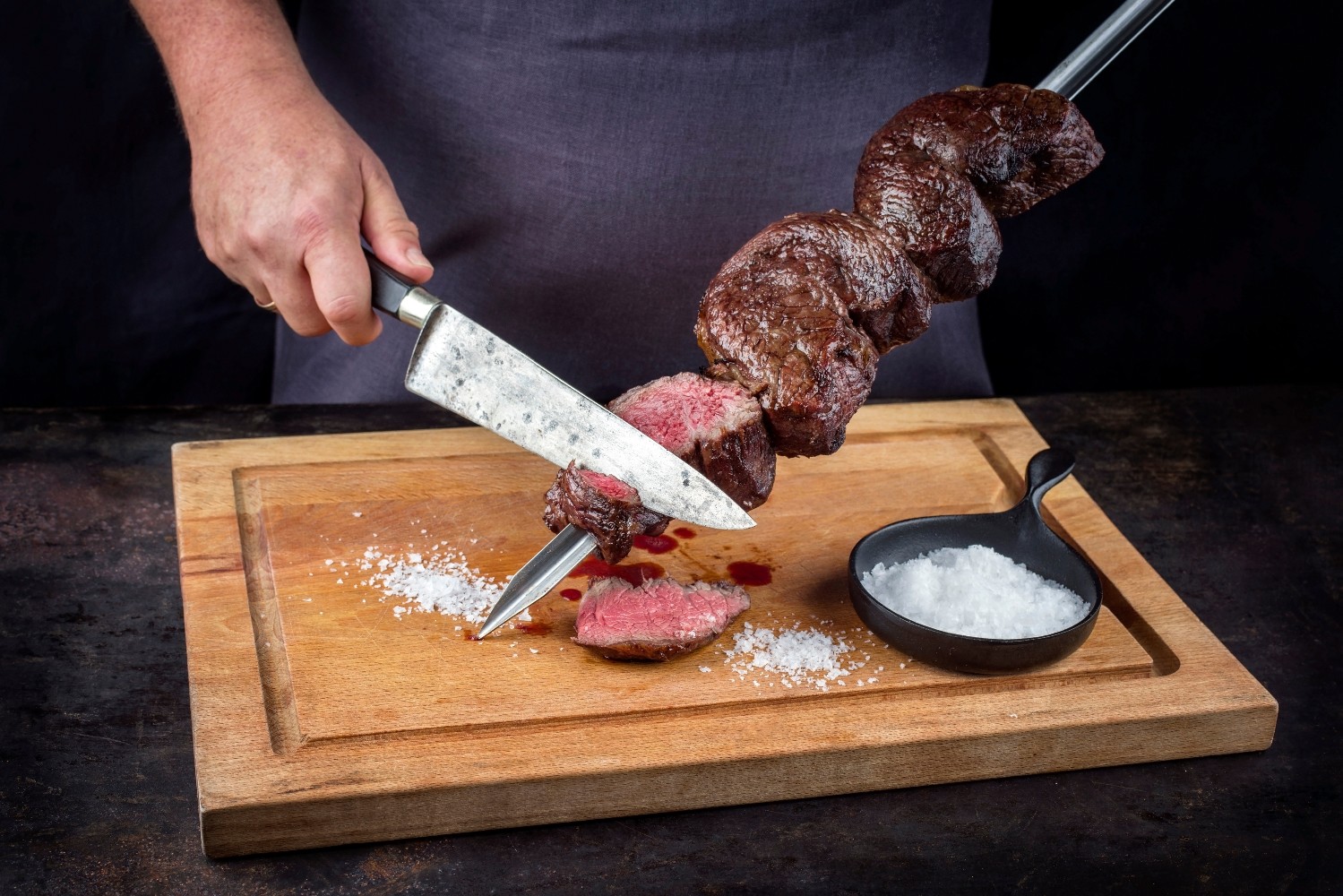
Brazilian rodizio is a style of food service where servers move continuously through a restaurant carrying large skewers of grilled meat and carving directly onto your plate. The word rodizio comes from the Portuguese verb rodiziar, meaning to rotate or take turns. Customers pay a fixed price and eat as much as they want for as long as they want. The meat keeps coming until you say stop.
That is the short answer. Here is what makes it worth understanding more deeply.
The Rodizio Experience
In Brazil, rodizio is not just a meal. It is an event.
The servers, called passadores, move through the dining room in a continuous rotation. Each carries a different cut: picanha, fraldinha, linguiça, chicken, lamb, pork ribs. They approach your table, you signal yes or no, and they carve directly onto your plate with a long knife in one fluid motion. Then they move to the next table and the cycle begins again.
Most rodizio restaurants use a small card or token at your place setting. Green side up means keep it coming. Red side up means you need a moment. The system is elegant and the pace is relentless in the best possible way.
The sides, called acompanhamentos, are typically served buffet style: white rice, Brazilian black beans, farofa, vinaigrette, grilled pineapple, fresh salads, and pao de queijo. You help yourself to those and let the passadores handle the protein.
A great rodizio in Brazil is fast-paced, loud, communal, and deeply satisfying. The flavors are bold and the cuts are served hot off the fire.
Rodizio in the United States
American rodizio restaurants like Rodizio Grill and Tucanos have done an impressive job bringing this style of service to the United States. They have honed the format, trained their servers in the tableside carving technique, and introduced millions of Americans to cuts like picanha and fraldinha that most people had never encountered before.
That is genuinely valuable and worth acknowledging. These restaurants created the market and built the appetite for Brazilian churrasco in cities across the country.
But there is one area where the economics of running a large restaurant operation creates a meaningful difference: the fire.
The Charcoal Difference
Running a restaurant at scale requires consistency, speed, and cost control. For many large churrascarias that has meant transitioning from traditional hardwood charcoal to gas grills. Gas is faster, more controllable, and significantly less expensive to operate at volume.
The difference shows up in the flavor. And nowhere is it more noticeable than in the pineapple.
I noticed it years ago and I have never stopped noticing it. Grilled pineapple over charcoal tastes different from grilled pineapple over gas. The caramelization is deeper. The smokiness is real. There is a complexity that gas simply cannot produce.
Here is why.
When you cook over hardwood charcoal, the heat rises and begins rendering the fat in the meat. As the fat liquefies it drips down onto the coals. When that rendered fat hits the hot charcoal it vaporizes instantly, sending a puff of fat-flavored smoke back up through the meat. The meat flavors the coals and the coals flavor the meat. Back and forth, continuously, for the entire cook.
That is the dance. And it is what makes charcoal churrasco taste the way it does.
Gas cannot replicate it. Gas produces clean, consistent heat with no smoke interaction and no fat rendering cycle. The meat cooks. But it does not participate in anything. The result is good. It is not the same.
Rodizio vs. Churrasco: What's the Difference?
People often use rodizio and churrasco interchangeably but they are not the same thing.
Churrasco is the food: Brazilian-style meat cooked on skewers over an open fire. It is the tradition, the technique, and the cuisine.
Rodizio is the service style: the continuous tableside rotation of servers bringing skewered meat to your table. A restaurant can serve churrasco without being rodizio. You can eat churrasco at home without any rotation service at all.
Think of it this way. Pizza is a food. Delivery is a service style. A pizzeria can make great pizza and deliver it, or make great pizza and have you pick it up. The quality of the pizza is separate from how it gets to you.
The Espeto Grill serves authentic Brazilian churrasco. It is not a rodizio operation. There are no passadores circling your table because your table is your own home. We cook the meat on a custom nine-zone churrasqueira over hardwood charcoal, package it hot, and you pick it up Saturday afternoon or we bring it to your door.
The food is the same tradition. The service is different. And we would argue that eating great churrasco in the comfort of your own home, at your own pace, with your own people, is its own kind of experience worth having.
Find Us in Lehi
If you have been curious about authentic Brazilian churrasco in Utah County, The Espeto Grill cooks every Saturday in Lehi. We use hardwood charcoal, not gas. You will taste the difference.
Order by Thursday at 10pm. Pick up Saturday between 3pm and 7pm, or we deliver within 5 miles of Lehi for a small fee. No reservation required, just an order.
Frequently Asked Questions About Brazilian Rodizio
What does rodizio mean in Portuguese? Rodizio comes from the Portuguese verb rodiziar, meaning to rotate or take turns. In the context of restaurants it refers to the continuous rotation of servers bringing different cuts of meat to each table.
Is rodizio the same as churrasco? No. Churrasco is the food, Brazilian-style skewer-grilled meat. Rodizio is the service style where servers rotate continuously through the dining room carving meat tableside. You can eat churrasco without rodizio service.
How does a rodizio restaurant work? At a traditional rodizio restaurant you pay a fixed price for unlimited meat service. Servers called passadores carry large skewers of different cuts and carve directly onto your plate. A green and red card or token at your place setting signals whether you want more meat or need a pause.
What is the difference between Rodizio Grill and authentic Brazilian rodizio? Rodizio Grill is an American restaurant chain that adapted the Brazilian rodizio service style for the US market. Authentic Brazilian rodizio in Brazil tends to be faster-paced, more casual, and often cooked over hardwood charcoal rather than gas. The core service format is similar.
Why does charcoal churrasco taste different from gas? Cooking over hardwood charcoal creates a continuous flavor exchange between the meat and the fire. As fat renders from the meat it drips onto the coals, vaporizes, and returns as fat-flavored smoke that penetrates the meat. This cycle repeats throughout the cook and produces a depth of flavor that gas cooking cannot replicate. The difference is most noticeable in the pineapple.
Can I get Brazilian churrasco without going to a restaurant? Yes. The Espeto Grill in Lehi, Utah offers authentic charcoal-fired Brazilian churrasco every Saturday for pickup or delivery. Order by Thursday at 10pm at espetogrill.com.