
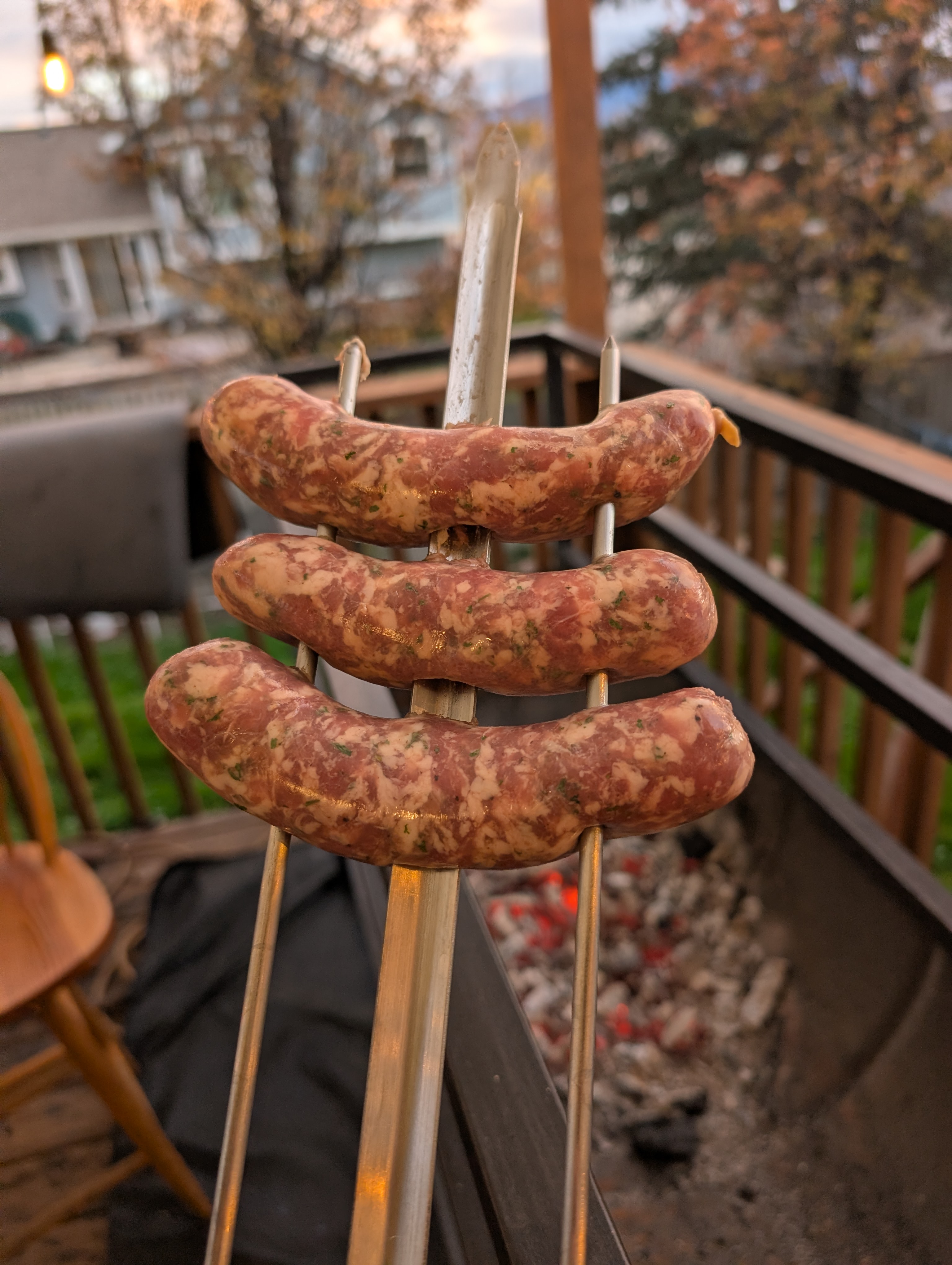
When I started looking into how to make linguiça toscana, I came across a sausage that needs a passport. It starts in Portugal, passes through Italy, settles in Brazil, and ends up on a grill in a Lehi driveway.
So, what is linguiça sausage? It's a pork sausage with Portuguese roots. The version on most Brazilian churrasco grills is linguiça toscana, and that's the one I grill and the one I know. It's fresh: no curing, no smoking, no drying time. It goes from the link to the fire.
Where I First Tasted Linguiça
I didn't grow up with Brazilian linguiça. I met it in Santa Catarina, in the Florianópolis region, sometime between 2001 and 2003. It was rich, full of flavor, and juicy.
Back home, it was hard to find for a very long time. Only in recent years have Brazilian stores started putting it on the shelf. I spent a lot of those years chasing that taste, and it made me ask where the sausage came from in the first place.
What Is Linguiça Sausage?
Linguiça is a Portuguese-style sausage with a long history in the food traditions of Portugal and Brazil. Like many traditional sausages, it began as a practical way to make use of pork and preserve meat for later consumption.
There are several varieties, and the name doesn't describe just one recipe or preparation method. Portuguese linguiça is often seasoned with garlic and paprika and may be smoked or dried. Brazilian versions developed their own characteristics, influenced by regional ingredients, immigration, and local cooking traditions.
The version I know best is linguiça toscana, the fresh pork sausage commonly found on Brazilian churrasco grills. Unlike the traditional smoked and dried varieties, the version I make is prepared fresh and goes from the link to the fire.
How Do You Pronounce Linguiça?
Linguiça is pronounced lin-GWEE-sah. The ç sounds like an s. If you type "linguica" without the accent, as plenty of people do, it's the same word.
Where the name comes from is a matter of some debate. It likely goes back to an old Italian or Roman sausage name, though writers disagree on which one, and I'll leave that argument to them.
How Did Linguiça Get From Portugal to Brazil?
Food writers commonly say linguiça came to Brazil with Portuguese colonists, as part of everyday Portuguese cooking. No historian pins it to a particular year, so it's safest to say it arrived with the Portuguese and stayed.
It changed along the way. Brazil's warmer, more humid climate meant less drying time, and local seasoning crept in. That's the first step toward the fresh sausage on my grill.
Linguiça is still part of feijoada, often called Brazil's national dish. If you're curious how deep Brazilian food runs in this part of Utah, Brazilian Food in Utah County: A Surprisingly Deep Connection is a good place to wander next.
How Did Linguiça Toscana Become a Churrasco Favorite?
The word toscana means Tuscan, pointing to the Italian region of Tuscany. But the linguiça toscana found on Brazilian churrasco grills is best understood as part of Brazil's own evolving sausage tradition.
Italian immigration brought a wide range of regional food traditions to Brazil, particularly during the late nineteenth and early twentieth centuries. Italian communities became especially influential in southern Brazil and in São Paulo, contributing to the country's growing culture of sausages, cured meats, pasta, and other familiar foods.
Over time, these traditions blended with existing Brazilian cooking practices. Linguiça toscana became one of the sausages associated with Brazilian grilling, particularly in the South.
To understand why it fits so naturally on the grill, it helps to understand the history of churrasco itself.
Brazilian churrasco is closely associated with the cattle-ranching culture of Rio Grande do Sul and the wider southern plains. Its history is tied to the region's cattle economy and the gauchos, the horsemen and ranch workers who developed a way of cooking meat over open fires.
The tradition evolved over generations, becoming a defining part of southern Brazilian food culture. Today, churrasco is enjoyed throughout Brazil, and sausages are often served alongside larger cuts of beef and pork.
That's where linguiça toscana found its place. It's relatively simple, flavorful, and well suited to cooking over charcoal. A linguicinha, or small sausage, is often served early in the meal while the larger cuts continue cooking.
It's a small part of a much bigger tradition, but ask someone who enjoys Brazilian churrasco, and they'll probably tell you that the sausage is every bit as welcome as the picanha.
Linguiça Toscana vs. Calabresa
Brazil has several varieties of linguiça, and two you'll commonly encounter are toscana and calabresa.
Linguiça calabresa takes its name from Calabria, in southern Italy, and reflects the influence of Italian immigrant communities on Brazilian sausage-making.
One account of its history traces early commercial production in São Paulo to the Açougue 7 de Setembro, a butcher shop opened in 1937. According to the family history reported by food writer Dias Lopes, the sausage was prepared by Giselda Cavallo, whose family had Calabrian roots. It was seasoned with Brazilian pimenta calabresa, giving it the characteristic spicy flavor we associate with the sausage today.
Calabresa is commonly cured and may be smoked, making it quite different from the fresh sausage I make.
Linguiça toscana, on the other hand, is the variety most closely associated with Brazilian churrasco. It has a milder seasoning profile and is made to be cooked fresh.
They're both Brazilian favorites, but they serve very different purposes in the kitchen.
Linguiça vs. Chorizo: What's the Difference?
It's easy to confuse linguiça with chorizo, especially because both come in several regional varieties. But they're not the same sausage.
Portuguese linguiça traditionally uses pork seasoned with ingredients such as garlic and paprika. Depending on the variety, it may be smoked, dried, or prepared fresh.
Brazilian linguiça toscana is generally recognized as a fresh-style sausage associated with churrasco.
Chorizo has its own distinct regional traditions. Spanish chorizo is typically cured and seasoned heavily with smoked paprika, while Mexican chorizo is generally fresh, highly seasoned, and often sold loose rather than in a traditional link.
They may share some ingredients and culinary ancestry, but each has its own identity.
For me, linguiça toscana is the one that brings back memories of Brazil. It's the one I wanted to learn to make.
Why Did I Start Making My Own Linguiça?
For years I went to Brazilian stores looking for linguiça, toscana, or even calabresa. In the early days I served whatever sausage I could get at a regular grocery store. As Brazilian stores became more common, I bought from them.
Eventually the cost of the sausage, and of getting it to me, got to be too much. Only a few months ago I had the idea to see if I could learn to make it myself. I've been practicing, and lately people have been reporting back that they like it.
This week is the first time it's being made from scratch for customers, and we're excited about that.
What Goes Into Our Linguiça Toscana?
Right now we only do linguiça toscana, as a starting point. As we refine it, we may expand into other versions.
We make it ourselves, from boneless pork butt and natural pork casings. We stuff the sausages, let them rest as you should, and then hand-twist the lengths. The recipe stays private for now, but it's a pork, fat, salt, garlic and pepper kind of sausage at heart, like most toscana.
The feedback has been honest. Testers like the consistency and the flavor. One thought it was a little heavy on garlic and salt, and another wanted a little more of both. I think the recipe is right where it should be. I've also used it in morning egg scrambles, and on a bun with homemade sauerkraut.
How to Grill Linguiça on the Espeto
At The Espeto Grill, I put the raw sausages onto Trident skewers. They're built like a normal meat skewer, but with two thick-gauge wire sides that hold sausages and other meats more steadily. What Are Brazilian Skewers? goes deeper on the espeto itself.
The grill is built so I can control the distance to the coals. Height from the heat source is how I manage the cook.
I use a meat thermometer every time. Plenty of guys cook by look and feel, but I'd rather know. Intact cuts are best at a solid medium-rare, 130 to 135. Sausage is different: it needs to reach 160 to 165, depending on the time frame.
I turn the sausage every 1.5 to 2 minutes. The heat doesn't stop working just because you've turned the sausage. Heat continues moving through the meat toward its cooler center. By turning the links regularly, I can develop even browning while allowing the inside to cook without scorching the casing.
How to Cook Linguiça at Home
You don't need a grill like mine. For fresh sausage like toscana, use a cast iron pan or something else heavy-duty. Set it on medium heat, add a little oil, and let it cook slowly.
The mistake I see most is heat that's too high. The outside chars before the heat reaches the center, and you end up with a black casing and a raw middle. Turn it down.
Flip the sausage about every 1 to 1.5 minutes. As the bottom builds heat, turn it over, and the heat keeps traveling to the center from the top while the other side charges back up. Go back and forth until a thermometer reads at least 160° to 165°. This is for fresh sausage only. Cured or smoked sausages cook differently, and I won't guess at timing for them.
Where to Buy Linguiça in Lehi
After all those years of looking for the right linguiça, I get a particular satisfaction out of being able to put it on our own Saturday plates. It's one of those ingredients that reminds me why I started The Espeto Grill in the first place. Brazilian stores sell it frozen, and I bought from them for years. At The Espeto Grill, it's on our Saturday plates. We cook it for plates and don't currently offer it raw.
Linguiça is on the grill November 21 and December 5. November 28 and December 12 feature different cuts, so check the menu for those weekends.
The Espeto Grill is a licensed Microenterprise Home Kitchen (Utah County Health Dept.), not a restaurant. Orders are prepaid online and close Thursday at midnight. Pickup is Saturday in time slots in our driveway in Lehi, and we also do local delivery.
Plates come as a One, Two or Three Meat Plate, or the Festa Pack (4 plates, feeds 4). Each one includes Abacaxi Grelhado (grilled pineapple), black beans, rice, farofa, vinagrete, 2 Pão de Queijo and one side choice. Cauliflower rice is a free swap for white rice.
Frequently Asked Questions
What is linguiça made of?
Linguiça is made from pork, usually with fat, and seasoned. Portuguese versions often use paprika, garlic and wine, while toscana is typically salt, garlic and pepper. Ours is made from boneless pork butt in natural pork casings, and the recipe stays private for now.
Is linguiça toscana cured or smoked?
No. Toscana is a fresh sausage, so it needs no curing, smoking or drying. It goes from the link to the fire, which is why it must be cooked all the way through.
What temperature should linguiça reach?
Fresh sausage should reach 160° to 165°. I check every time with a meat thermometer rather than going by look and feel.
Where can I buy linguiça in Lehi?
Brazilian stores carry it. At The Espeto Grill, you can get it on a Saturday plate, though we don't currently sell it raw.
Come Get a Plate
If you'd like to taste it, order by Thursday at midnight at espetogrill.com/order and pick up on Saturday. I hope to see you in the driveway.